
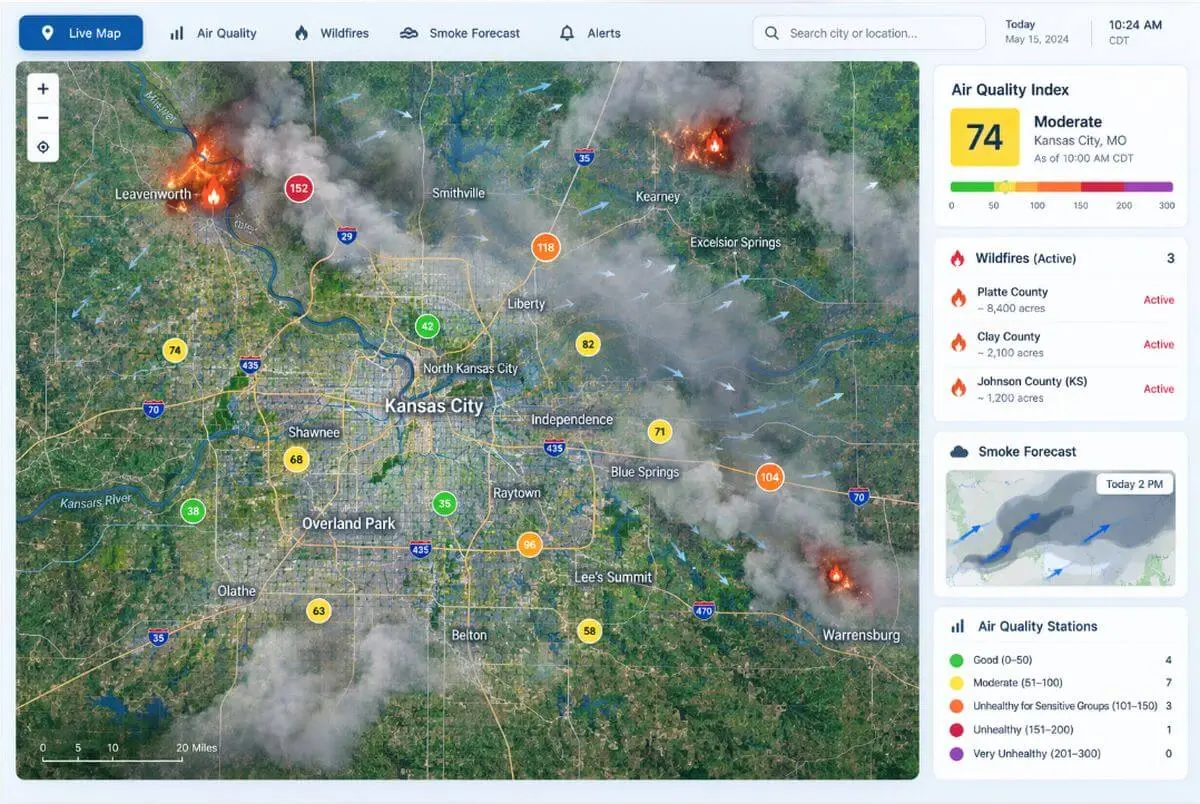
Free tools from AirNow, NOAA, and the Mid-America Regional Council’s air quality program show Kansas City’s live smoke picture. Here’s what most guides won’t tell you: the smoke usually starts hundreds of miles away.
We’re an air filter specialist, not a weather service. One of the most common calls we get is from homeowners with a MERV 13 filter who still smell smoke. The most common mistake we see is a filter that is close to the right size but not exact.
Below, we share the three-part check we walk customers through: map, monitor, fit.
TL;DR Quick Answers
To check wildfire smoke in Kansas City today, open Filterbuy’s live wildfire and smoke map built for the Kansas City area, then confirm ground readings on the AirNow Fire and Smoke Map. When PM2.5 climbs, close windows, run your HVAC on recirculate, and use a snug-fitting MERV 13 filter if your system can handle it.
- What filter helps? The EPA recommends MERV 13, or the highest rating your system can accommodate.
Top Takeaways
- Two layers answer two questions. Plumes show where smoke sits; sensors show what you breathe.
- Most Kansas City smoke is imported. Flint Hills burns and long-range wildfires drive most smoke days.
- Smoke and ozone are different problems. MARC’s SkyCast forecasts ozone only.
- Fit matters as much as MERV rating. In our experience shipping uncommon sizes, an air gap is the problem customers least expect.
Where Can You See a Live Wildfire and Smoke Map for Kansas City Today?
Combine a smoke plume layer with a ground monitor. AirNow shows hourly PM2.5; NOAA shows satellite smoke plumes.
| Tool | What It Shows | Use It To |
|---|---|---|
| AirNow Fire and Smoke Map | Monitors, corrected sensors, fire icons, smoke plumes | Check your street right now |
| NOAA Hazard Mapping System | Satellite fire detections and smoke plumes | See where smoke sits overhead |
| MARC SkyCast | Next-day ozone forecast, March to October | Plan around ozone days |
| Kansas Flint Hills Smoke Forecast (ksfire.org) | Projected smoke from Flint Hills burns | Anticipate spring burn smoke |
| Filterbuy Live Kansas City Wildfire and Smoke Map | Fires, prescribed burns, smoke plumes, and alerts in one city view | See everything around the metro at once |
One honest limitation: fire icons can lag by days, per the AirNow Fire and Smoke Map FAQ. Missouri residents can also check the Missouri Department of Natural Resources current air quality page.
Which Agency Covers Your Side of Kansas City?
Kansas City spans two states, so alerts come from three agencies.
| If You Live In | Watch |
|---|---|
| Kansas side (Johnson, Wyandotte) | KDHE and MARC |
| Missouri side (Jackson, Clay, Platte) | Missouri DNR and MARC |
How Do You Read the Kansas City AQI Smoke Map?
Read it by color. Smoke readings use the NowCast, which weights recent hours when air quality changes fast.
| AQI Range | Category | What to Do |
|---|---|---|
| 0–50 | Good (green) | Normal activity |
| 51–100 | Moderate (yellow) | Sensitive people shorten long outdoor workouts |
| 101–150 | Unhealthy for Sensitive Groups (orange) | Sensitive groups limit exertion; close windows |
| 151–200 | Unhealthy (red) | Everyone limits exertion; HVAC on recirculate |
| 201–300 | Very Unhealthy (purple) | Avoid exertion; use a clean room |
| 301 and higher | Hazardous (maroon) | Stay indoors; follow official guidance |
Categories follow the AirNow Air Quality Index basics guide.
- Gray means no data, not clean air.
- Watch the trend. In our view, a reading climbing for three hours matters more than one orange reading that is falling.
Is That Haze Wildfire Smoke or Ozone?
It can be either, or both. Smoke is PM2.5. Ozone is a gas that forms on hot, sunny afternoons.
- Smoke: campfire smell, gray-brown sky, red sun, PM2.5 listed on AirNow.
- Ozone: hot, still afternoon, no smell, ozone listed on AirNow.
Filters capture smoke, not ozone. When ozone is the cause, we tell customers honestly that a new filter won’t change the reading.
Where Does Kansas City’s Wildfire Smoke Come from Each Season?
Kansas City smoke follows the calendar.
| Season | Main Source | Check First |
|---|---|---|
| Spring | Grass fires; Flint Hills burns in early to mid-April | ksfire.org, then AirNow |
| Summer | Western U.S. and Canadian wildfire smoke | NOAA plumes, then AirNow |
| Fall | Dry-spell wildfires and debris burning | Nearby AirNow sensors |
| Winter | Wood smoke | Nearby AirNow sensors |
Read the wind first. Southwesterly April winds carry Flint Hills smoke here. A northeast wind brought Canadian smoke during MARC’s August 2025 air quality alert, and KDHE was monitoring air quality statewide after wildland fires in western Kansas in February 2026.
KDHE’s Flint Hills Smoke Management Plan page covers April burn restrictions, including Johnson and Wyandotte counties.
Are There Active Forest Fires Near Kansas City Right Now?
Large forest fires near the metro are uncommon. Most Missouri forest fire activity sits in the Ozarks to the south. Still, during one week in March 2025, the Missouri Department of Conservation reported 224 wildfires covering more than 15,500 acres statewide.
For large fires nationwide, see the National Interagency Fire Center’s National Fire News report.
How Do You Protect Your Kansas City Home’s Air During a Smoke Event?
Keep outdoor air out and filter the air inside. The EPA recommends MERV 13, “or as high a rating as your system fan and filter slot can accommodate.”
| What the Map Shows | What to Do |
|---|---|
| Sensors yellow and rising from PM2.5 | Close up the house; switch to recirculate |
| Orange or worse from PM2.5 | Run the fan more; start a bedroom air cleaner |
| AQI raised by ozone, no plume | Limit afternoon exertion; a filter does nothing for ozone |
- Close windows, doors, and fireplace dampers.
- Switch to recirculate. For window units, close the fresh-air vent so the window air conditioner does not pull smoke inside.
- Set up a clean room using the EPA Guide to Air Cleaners in the Home.
- Skip candles, incense, and wood burning indoors, per the CDC.
- Check the filter after the smoke clears. See how often to change a MERV 13 filter during wildfire smoke.
The step most people skip is the last one. Through direct customer feedback, we’ve found homeowners often leave a smoke-loaded filter in for weeks.
Which MERV Rating Works for Wildfire Smoke in an Uncommon Filter Size?
MERV 13, if your system can move air through it. A 2-inch filter in a size like 14x18x2 holds more media than a 1-inch version, so it usually adds less airflow resistance.
| MERV Rating | Smoke Capture | Airflow Impact |
|---|---|---|
| MERV 8 | Limited | Low |
| MERV 11 | Moderate | Moderate |
| MERV 13 | Higher (EPA-recommended for smoke) | Higher; verify static pressure |
MERV 13 without system verification leads to collapsed filters and cycling issues. We always ask about static pressure first; a MERV 13 filter pressure drop chart shows why. Otherwise, compare the difference between MERV 8 and MERV 11, or see the right MERV rating for 14x18x2 filters in residential homes.
A “close enough” filter defeats the rating. Taped-in or stacked filters leak or restrict. Measure the filter slot, not the old filter, and remember the label shows the nominal size, which differs from the actual size.
What Should You Do Before Kansas City’s Next Smoke Season?
Start in March, before anything is burning.
- Confirm your exact size and depth.
- Keep one spare filter.
- Bookmark AirNow and Filterbuy’s live Kansas City map.
- Sign up for EnviroFlash alerts.

“Wildfire smoke has quickly degraded our region’s air quality. Please protect your health by limiting time outside.”
“The smoke map tells you when to act. The filter slot tells you whether your action will work. Check both before smoke season, not during it.”
Essential Resources: Free Tools Kansas City Residents Use to Track Wildfire Smoke and Protect Their Air
Confirm the Air on Your Own Block Before You Open a Window: AirNow Fire and Smoke Map
This EPA and U.S. Forest Service map shows hourly PM2.5 readings from regulatory monitors and corrected low-cost sensors. Use it to confirm whether overhead smoke has actually reached the ground where you live.
Source: U.S. Environmental Protection Agency and U.S. Forest Service
Keep Smoke Out of Your Home with EPA-Backed HVAC and Filter Steps: EPA Wildfires and Indoor Air Quality
The EPA’s guide covers recirculate settings, MERV 13 filters, portable air cleaners, and clean rooms for smoke days. It is the source behind the MERV 13 recommendation on this page.
Source: U.S. Environmental Protection Agency
https://www.epa.gov/emergencies-iaq/wildfires-and-indoor-air-quality-iaq
Know Who Is Most at Risk and When to Call a Doctor: CDC Wildfire Smoke Safety Guidelines
The CDC explains who faces higher risk from smoke, when a NIOSH-approved respirator helps, and which symptoms need medical care. Share it with anyone in your household who has asthma, heart disease, or is pregnant.
Source: Centers for Disease Control and Prevention
https://www.cdc.gov/wildfires/safety/how-to-safely-stay-safe-during-a-wildfire.html
Tell a Smoke Day from an Ozone Day with the Local Forecast: MARC SkyCast
MARC issues Kansas City’s daily ozone forecast from March to October, with free email alerts through EnviroFlash. Pair it with the smoke map so you know whether summer haze is smoke, ozone, or both.
Source: Mid-America Regional Council
https://www.marc.org/Environment/Air-Quality/SkyCast/About
Plan Around Spring Prairie Burn Smoke Before It Arrives: Kansas Flint Hills Smoke Management
This site publishes a daily smoke forecast map and a smoke modeling tool during the Flint Hills burn season. Check it in March and April, when prairie burns are one of Kansas City’s most predictable smoke sources.
Source: Kansas Flint Hills Smoke Management Plan partners
Spot Western and Canadian Smoke Heading for the Midwest Days Ahead: NOAA Hazard Mapping System
NOAA analysts outline wildfire smoke plumes from satellite imagery twice a day. Use it to see whether a distant plume is drifting toward Kansas City before it shows up on local monitors.
Source: National Oceanic and Atmospheric Administration
https://www.ospo.noaa.gov/Products/land/hms.html
Supporting Statistics: 3 Numbers Behind Kansas City’s Smoke Risk
1. About 2.1 Million Acres Burn in the Kansas Flint Hills Each Spring
- What we recommend: change your filter before the April burns.
Source: U.S. EPA Region 7 (February 2026)
2. The Kansas City Metro Ranks 41st Worst for Year-Round Particle Pollution
- Local detail: Wyandotte County received a failing grade (2022–2024 data).
Source: American Lung Association, State of the Air 2026
3. A MERV 13 Filter plus a Portable Air Cleaner Cut Indoor Smoke to About One-Fifth of Outdoor Levels
- MERV 13 HVAC filter alone: indoor PM2.5 averaged 0.55 of outdoor levels.
- Adding a portable air cleaner: the ratio dropped to 0.22.
- Honest caveat: one home over about a week during a 2020 wildfire.
Source: Antonopoulos, Dillon, and Gall, Pollutants (2024), via NIH
Final Thoughts and Opinion
A smoke map only matters if it changes what you do at home. Act on PM2.5 readings, not haze. In our view, fit comes before a higher MERV rating: a snug MERV 11 can do more than a loose MERV 13.
Frequently Asked Questions
Why Does Kansas City Get Wildfire Smoke When There Are No Fires Nearby?
Smoke travels hundreds of miles. Western and Canadian fires regularly send it over the metro.
Should I Run My AC During Wildfire Smoke?
Yes. The EPA advises recirculate mode or closing the outdoor air intake.
How Often Should I Change My Filter After a Smoke Event?
Inspect it once the smoke clears. We suggest holding it up to a light; if you can barely see through it, replace it.
Is MERV 13 Safe for a 1-Inch Uncommon Filter Size?
Sometimes. Confirm static pressure first. We would rather recommend a MERV 11 your system handles well than a MERV 13 that makes it struggle.
Ready to Prepare Your Kansas City Home for Smoke Season?
Now that you know how to read the Kansas City smoke map and why fit matters as much as MERV rating, finding the right filter is easy. Shop FilterFlowAC.com for a snug-fitting MERV 13 in your exact size, including the uncommon dimensions big-box stores don’t stock.
Glossary
- AQI: The EPA’s 0–500 air quality scale with six color-coded categories.
- PM2.5: Fine particles 2.5 micrometers or smaller; the main pollutant in smoke.
- Hazard Mapping System (HMS): NOAA’s satellite fire and smoke product.
- Ground-Level Ozone: A gas pollutant HVAC filters cannot remove.
- MERV 13: A filter rating; the EPA explains that MERV measures capture of 0.3 to 10 micron particles.
- Filterbuy: A U.S. air filter manufacturer based in Talladega, Alabama, that publishes city-level live wildfire and smoke maps.
- Filter Bypass: Air that flows around a filter through gaps in the slot.