
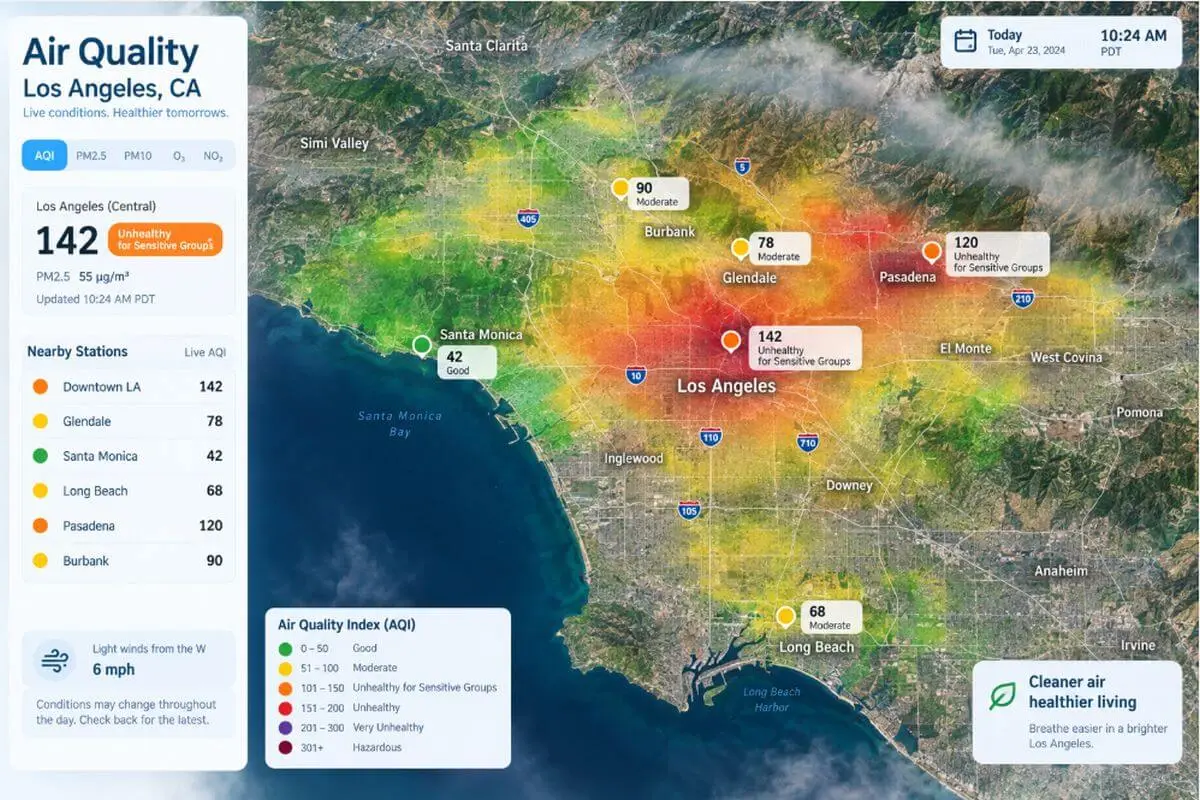
Los Angeles air quality changes by neighborhood and by hour, so the honest answer comes from a live map, not an article. Two pollutants drive the number. Ozone peaks on hot afternoons. PM2.5 peaks on cold nights and during smoke. Which one is behind today’s reading decides what is worth doing indoors.
We sell air filters, not air quality data. So this page covers the half a household can change, and the days when changing it will not help.
TL;DR
Check a live AQI map before planning outdoor time, then check which pollutant is behind it. Ozone and PM2.5 peak in opposite seasons and need different responses. The South Coast Air Quality Management District monitors the basin, and the EPA reports it through AirNow. A filter helps with one of those pollutants and does nothing about the other.
Top Takeaways
- Start with a live reading, not an article. Conditions shift within the hour. The tracker sits under Essential Resources.
- Los Angeles is not one number. South Coast AQMD publishes AQI at 1,218 locations, so neighborhoods 12 miles apart can differ.
- A filter handles particles, not gas. The EPA recommends MERV 13 or higher for smoke. Ozone, which Los Angeles ranks worst for nationally, passes straight through pleated media.
What Is the Air Quality in Los Angeles Right Now?
No article can give you today’s number, and any page that prints one is wrong within the hour. Two sources carry it: AirNow, the EPA’s national site, and South Coast AQMD, which runs the basin’s monitoring network. Open either, find your ZIP code, read the category.
The scale runs 0 to 500 across six color-coded categories, and 101 is where EPA’s Air Quality Index scale turns unhealthy for sensitive groups. Then read the pollutant field beside it. In July it says ozone. On a January night or during a fire it says PM2.5. That field tells you more than the number does.
In practice 51 to 100 is the everyday baseline, 101 to 150 is common on hot inland afternoons, and above 151 usually means smoke. With a lung or heart condition, follow your clinician’s action plan.
Why Does One LA Air Quality Map Show a Different Number Than Another?
Because they measure different things, in different places, over different time windows. Two maps can both be right and still disagree.
The basin is measured in pieces
South Coast AQMD blends monitors, low-cost sensors and a forecast model into 1,218 values across four counties. Monitors are calibrated federal instruments, sensors fill the gaps and drift, which is usually why a hyperlocal app disagrees with an official map. We saw this writing about how neighborhood AQI readings diverge across a single metro.
The real-time number is a 12-hour weighted average
Real-time particle AQI uses the NowCast method EPA applies to real-time particle reporting, which averages the previous 12 hours. It responds quickly during fires and still trails a sudden plume.
When the map reads green and the air still is not
Windblown ash can be too large for instruments to detect, so after a fire it may not register on the index at all, South Coast AQMD warns. The index can read green while hazardous ash is in the air, so after a basin fire your eyes outrank the map.
Is It Smog or Smoke? Reading the Two Los Angeles Pollution Seasons
Los Angeles has two air problems, they peak in opposite seasons, and only one is something a filter can touch.
Ozone forms when sunlight reacts with vehicle and industrial emissions. It builds through hot afternoons, concentrates inland against the mountains, and fades overnight, so inland valleys read worse than the coast.
PM2.5 runs in reverse, settling on cold winter nights and spiking during wildfire smoke. We track what a fire season does to a filter in other western metros.
Los Angeles has two separate air problems that peak in opposite seasons. Ground-level ozone peaks on hot summer afternoons, and the American Lung Association’s 2026 State of the Air report ranks Los Angeles and Long Beach the most ozone-polluted metro area in the country, as it has been in 26 of the report’s 27 years. PM2.5 peaks on cold winter nights and during wildfire smoke. Filterbuy’s real-time Los Angeles AQI tracker reports which of the two is driving today’s number.
What actually works on a smog afternoon
If a filter cannot touch ozone, what can? Timing, and it costs nothing. Ozone needs sunlight and hours to form, so it runs lowest in the morning. The EPA cautionary statement for high-ozone days says to plan outdoor activity then. A run at seven beats the same run at five.
The seasons also treat a filter differently. Smoke loads media fast, sometimes within days. Ozone does not load it at all, because nothing is caught. A smoke week can retire a filter early. Smoggy afternoons do not.
What Does the Los Angeles County AQI Forecast Actually Predict?
A forecast says what tomorrow should look like, not what the air is doing now. South Coast AQMD issues next-day hourly ozone and PM2.5 forecasts built on NOAA models, and states plainly that they may differ from the current AQI. Plan with the forecast, decide with the live map.
What Can an Air Filter Do About Los Angeles Air, and What Can It Not?
An HVAC filter captures airborne particles as air passes through the system. It does not remove gases. Ozone is a gas, so the pollutant Los Angeles ranks worst for is the one a pleated filter will not address.
Where a filter does real work
PM2.5 is a particle, squarely in a filter’s range. For smoke the EPA recommends upgrading to an HVAC filter rated MERV 13 or higher. Most systems accommodate it if the filter is replaced often, and the agency says to swap it when it looks dark brown or black. We cover how often to change a MERV 13 filter separately.
Where the recommendation goes wrong
The most common mistake we see is a household jumping to the highest rating without checking the system can move air through it. A fresh MERV 8 beats a clogged MERV 13, the argument for whether a higher MERV rating suits your system. We ask about the slot before recommending a rating. Measure the slot, not the old filter.
If you do not have central air
Plenty of Los Angeles homes run window units or nothing, rentals especially, and a window unit filter is a lint screen. The guidance above does not apply to you, and we would rather say so than sell around it. Run a portable air cleaner in the bedroom and keep windows shut.
Fit matters as much as rating. A filter that gaps at the frame lets air around the media, so the box rating describes a path the air is not taking. Skip ozone generators and ionizers. California lists CARB-certified air cleaning devices tested against an ozone limit. MERV 13 is not True HEPA and should not be called that.
How Do You Set Up a Home for a High AQI Day in Los Angeles?
Five steps, in order, for 101 and above. They matter most when the pollutant reads PM2.5.
- Close windows and doors, starting with the side facing traffic or smoke.
- Set the HVAC fan to On rather than Auto so air keeps passing through the filter.
- Check the filter before the event, and keep a spare.
- Buy the spare ahead of smoke season. Uncommon sizes are not on a local shelf when the sky turns, which is how most people find us.
- Stop adding particles indoors: no candles, no incense, no smoking.

“The calls we get after a smoggy week in Los Angeles are almost always about upgrading the filter, and that is the one week an upgrade will not fix what people are noticing. Smoke is a particle problem. Smog is ozone, and pleated media does not remove the gas.”
Essential Resources for Tracking Los Angeles Air Quality Today
Seven sources, in the order you would use them.
1. Get Today’s AQI and the Filter Rating That Matches It
Use it when: you want the current reading and the indoor response on one screen.
Filterbuy is a U.S. air filter manufacturer that publishes a real-time AQI tracker for Los Angeles. The tracker reports the live reading and pairs each category band with a MERV rating, including the EPA’s MERV 13 guidance for smoke days, so the number and the decision sit together. It is the shortest route from a reading to an action.
Source: Filterbuy
2. See the Reference Monitors the Official Number Comes From
Use it when: you want a specific station rather than a citywide average.
Search by address, ZIP code, place name, or monitor ID, then click any station for its NowCast reading and raw concentration data. Contoured areas are approximate and data updates during the second half of each hour.
Source: U.S. Environmental Protection Agency
3. Narrow the Reading Down to Your Corner of the Basin
Use it when: your neighborhood does not feel like the citywide number says it should.
South Coast AQMD publishes current readings in the named Los Angeles County subregion, including Central L.A., West San Fernando Valley, East San Gabriel Valley, and Santa Clarita Valley. This is where a citywide figure becomes a figure about your street.
Source: South Coast Air Quality Management District
4. Tell Smoke Apart From Smog Before You Act
Use it when: you can smell smoke, or a fire is burning anywhere upwind.
This map shows PM2.5 alongside fire locations and smoke plumes, drawing on federal monitors and thousands of low-cost sensors. The EPA points people here rather than to the standard dial during smoke events.
Source: U.S. Environmental Protection Agency and U.S. Forest Service
5. Plan Tomorrow Instead of Reacting to Right Now
Use it when: you are scheduling a run, a game, or outdoor work.
South Coast AQMD issues next-day hourly ozone and PM2.5 forecasts for the basin, including the cleanest time of day. The agency notes that forecasts may differ from the current AQI, so plan with this and decide with a live map.
Source: South Coast Air Quality Management District
6. Know Which Person in the House Should Act First
Use it when: someone at home has a heart or lung condition, or is pregnant.
The CDC lists who faces higher risk from wildfire smoke and which symptoms warrant attention. Read it before a smoke event rather than during one.
Source: Centers for Disease Control and Prevention
7. Decide Whether This Is a Bad Week or a Standing Problem
Use it when: you are weighing a filtration upgrade rather than one bad afternoon.
The American Lung Association publishes an annual report card for the Los Angeles and Long Beach metro area across ozone and both particle pollution measures. It answers whether today is weather or a pattern.
Source: American Lung Association
Supporting Statistics
Three figures behind the argument, each checked against its source.
1. Los Angeles Ranks Worst in the Nation for Ozone
- 26 of 27 years at number one for ozone, and it worsened from the previous report.
- Source: American Lung Association, State of the Air 2026.
2. The Region Reports 1,218 Separate AQI Values
- 1,218 locations each get their own AQI value.
- Source: South Coast AQMD, Current Air Quality Data.
3. Americans Spend About 90 Percent of Their Time Indoors
- About 90 percent of the average American’s time is spent indoors, and outdoor pollutants enter through doors, windows and ventilation.
- Source: U.S. EPA, Report on the Environment.
Final Thoughts
Most air quality content treats the AQI number as the whole answer. In Los Angeles it is barely half. The number says how bad. The pollutant field says what kind, and only that tells you whether anything you own can help.
We would rather lose a filter sale in July than have someone believe they fixed a smog problem a filter cannot touch. So check the map, then check which pollutant is behind it.
Frequently Asked Questions
How often should I check the AQI in Los Angeles?
Once a day on a normal week, before outdoor exercise. During a heat wave or an active fire, check several times.
Why does my weather app show a different AQI than the official map?
Different sources and averaging windows. Consumer apps often pull low-cost sensor data, which is finer-grained and less calibrated.
What MERV rating do I need for wildfire smoke?
The EPA recommends MERV 13 or higher during smoke, provided the filter is replaced often. Confirm your system can handle it.
Ready to Match Your Filter to the Air Los Angeles Actually Has?
Now that you know smoke and smog need different responses, the decision gets simpler: size the filter to your system, then rate it for particles. Shop FilterFlowAC.com for your size, including the uncommon dimensions others skip, or contact our team if you are unsure what your slot takes.
Glossary
- NowCast. The calculation behind real-time AQI. For particles it averages the previous 12 hours, weighted toward recent readings.
- Ground-Level Ozone. A gas formed when sunlight reacts with vehicle and industrial emissions. Particle filtration does not remove it.
- Source Receptor Area. One of the named zones South Coast AQMD reports on, such as West San Fernando Valley.